
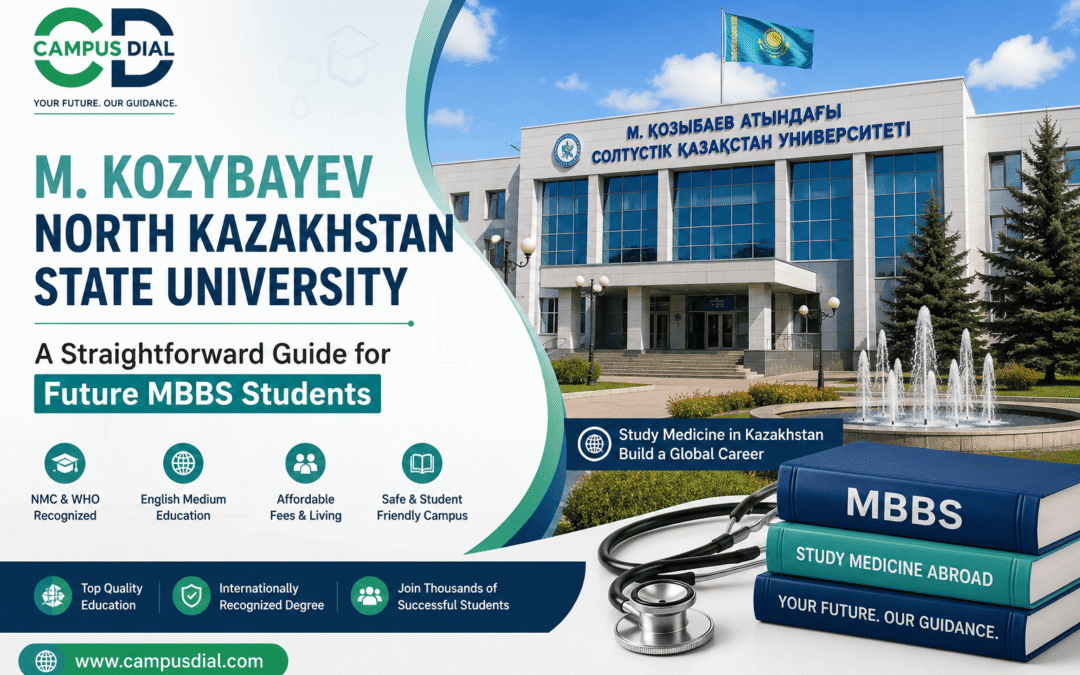
If Almaty is the name everyone throws around when they talk about MBBS in Kazakhstan, Petropavl is the quieter alternative that a smaller but growing number of students are choosing instead. And the university at the center of that shift is M. Kozybayev North Kazakhstan State University, often shortened to NKSU or simply “Kozybayev University.”
It doesn’t have the same brand recognition as some of the bigger names in Almaty or Astana, and honestly, that’s part of why it’s worth a closer look — smaller intake, lower fees, and a campus that isn’t stretched thin trying to accommodate thousands of international students at once. Let’s go through what it actually offers.
A Bit of Background
NKSU has roots going back to 1937, when it was founded as the Petropavlovsk Teachers Training Institute — originally a training ground for educators, not doctors. Over the following decades it evolved into a full university, earning that formal status from the government in 2001. In 2003, the institution was renamed in honor of Manash Kozybayev, a respected Kazakh historian and academic, which is why you’ll see it referred to almost interchangeably as NKSU and Kozybayev University.
Today it operates as a public, state-funded university, offering a fairly wide academic spread — natural sciences, engineering, humanities, social sciences, and, most relevant for international students, medicine.
Where It’s Located, and Why That Matters
NKSU sits in Petropavl (also spelled Petropavlovsk), the administrative center of Kazakhstan’s North Kazakhstan Region. It’s a much smaller, quieter city than Almaty, and that shapes the whole experience in ways prospective students should think through honestly before applying.
On the plus side, Petropavl is calm, affordable, and less overwhelming for a first-time international student. Living costs tend to run lower than in the bigger cities, and the pace of life is slower.
On the other hand, it’s a smaller city with fewer direct international flight connections, which means more layovers when you’re heading home for breaks. Winters here are also genuinely harsh — northern Kazakhstan gets considerably colder than Almaty, so this is a real factor if you’re coming from a tropical or subtropical climate and haven’t dealt with serious winter conditions before.
The MBBS / General Medicine Program
The medical program at NKSU generally runs 5 to 6 years depending on the specific track, following the standard pattern for Kazakh medical education: foundational science subjects in the earlier semesters, moving into clinical subjects like internal medicine, surgery, pediatrics, gynecology, ENT, emergency medicine, cardiology, neurology, and oncology in the later years, plus a supervised internship period.
Classes for international students are conducted in English, so language isn’t a barrier to enrollment, though students who pick up conversational Russian or Kazakh tend to find clinical rotations and daily hospital interactions noticeably smoother.
Recognition and Post-Graduation Value
This is the part every prospective student should scrutinize carefully, regardless of which university they’re considering. NKSU holds recognition from bodies that matter for international practice, including listings tied to WHO and FAIMER’s World Directory of Medical Schools, along with accreditation from Kazakhstan’s own quality assurance bodies (IQAA and IAAR).
For Indian students specifically, the degree needs to align with National Medical Commission requirements, and graduates will still need to clear the FMGE (or its successor, NExT) to practice back home — the same requirement that applies no matter which foreign medical university you attend. Don’t let anyone tell you a degree from any university abroad, including this one, exempts you from that step.
Fees: The Actual Draw
Let’s be honest about why NKSU keeps coming up in student forums and consultant recommendations — it’s genuinely one of the more budget-friendly public medical university options in Kazakhstan. Annual tuition typically falls somewhere in the $3,500–$4,000 range, noticeably lower than what you’d pay at some of the larger, more internationally known universities in Almaty or Astana.
Beyond tuition, factor in:
- Hostel accommodation
- Food and daily expenses (generally lower here than in bigger cities)
- Visa and document processing
- Health insurance
- Winter clothing and heating-related costs, which are a real line item given the climate
Some sources mention scholarship opportunities tied to NEET scores, offering partial tuition waivers for students who score within certain bands. If cost is a major factor in your decision, it’s worth asking the admissions office directly what scholarships are currently active for your intake year, since these programs tend to shift from year to year.
Admission Process
The admission pathway follows a familiar structure for Kazakh medical universities:
- Complete higher secondary education with Physics, Chemistry, and Biology.
- Indian applicants need a valid NEET score — there’s generally no separate university entrance exam.
- Submit your application along with a passport (valid for at least a couple of years), academic transcripts, and other standard documents.
- Receive an admission offer and official invitation letter.
- Use that invitation letter to apply for your Kazakh student visa.
Because there’s no additional entrance exam layered on top of NEET, the process tends to move a bit faster than at universities requiring separate testing.
Should You Choose NKSU Over a Bigger-Name University?
This really comes down to what kind of experience you want.
If you’d rather study in a smaller, quieter city, pay less in tuition and daily living costs, and don’t mind fewer direct flights and colder winters, NKSU is a reasonable, budget-conscious choice with legitimate international recognition behind it.
If you want the buzz of a large international student community, more flight connectivity, and a city with more going on outside the classroom, you might lean toward a university in Almaty instead — though you’ll typically pay more for that.
Neither choice is objectively “better.” It depends on your budget, your tolerance for cold winters, and how much you value being in a bigger city versus a calmer one.
Final Word
M. Kozybayev North Kazakhstan State University isn’t trying to be flashy, and it doesn’t need to be. It offers a straightforward, English-medium MBBS program, recognized credentials, and one of the more affordable tuition structures among Kazakhstan’s public medical universities. For students who are clear-eyed about the trade-offs — a smaller city, a colder climate, fewer flights home — it’s a genuinely solid option worth putting on your shortlist.
As always, confirm current fees, scholarship availability, and admission deadlines directly through the university or a verified official source before making any commitments.
Want to compare more Kazakhstan MBBS options side by side? Browse more university guides on CampusDial to find the right fit for your goals and budget.