
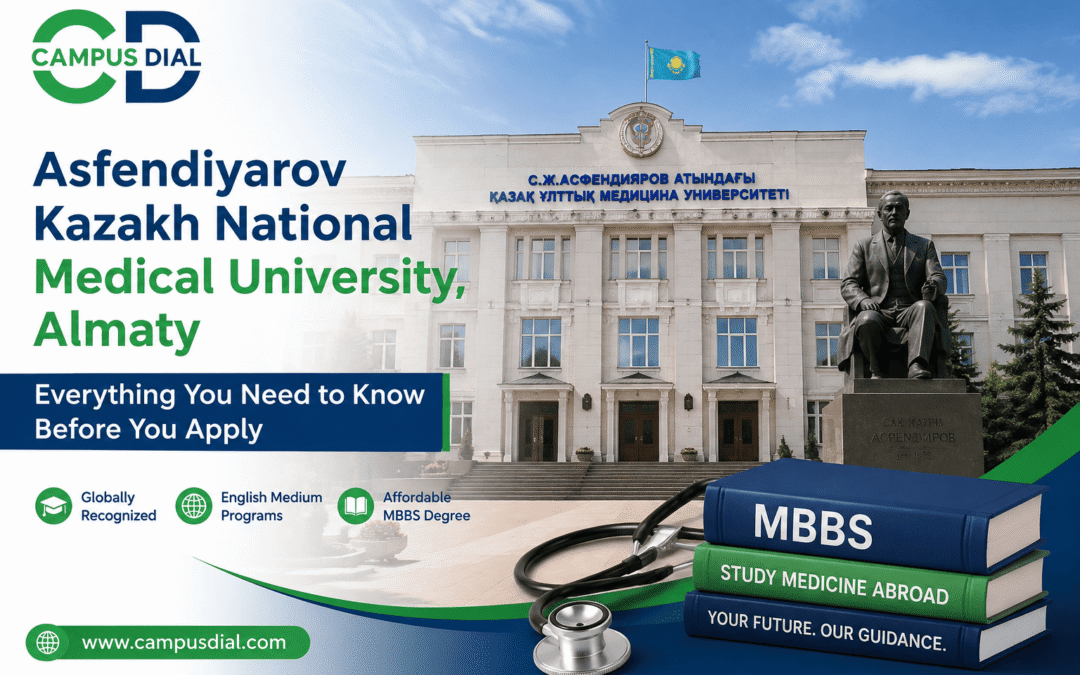
If you’ve been researching MBBS abroad for more than a few days, you’ve probably run into the name Asfendiyarov Kazakh National Medical University at least a dozen times. It comes up constantly in conversations about studying medicine in Kazakhstan, and there’s a good reason for that — it’s one of the oldest, largest, and most established medical universities in the country.
But most of what’s floating around online about this university is either recycled marketing copy or scattered half-facts. So let’s slow down and actually walk through what KazNMU is, what it offers, and what you should know before you commit years of your life and a fair bit of money to studying there.
A Quick Introduction to KazNMU
Asfendiyarov Kazakh National Medical University, usually shortened to KazNMU, is located in Almaty — Kazakhstan’s largest and most culturally vibrant city. The university has been around since 1930, which makes it nearly a century old at this point. It started out as the Alma-Ata State Medical Institute before being renamed after Sanjar Asfendiyarov, a respected Kazakh physician and public figure who served as its first rector.
In 2001, the Kazakh government officially designated it a “National” university, a title that isn’t handed out casually. And by 2019, it had earned recognition as a National Medical Research University, reflecting its growing focus on research alongside teaching.
Today, KazNMU is home to roughly 10,000 to 11,000 students, with a meaningful chunk of that number — around 1,700 or more — coming from outside Kazakhstan. That international mix matters more than people usually give it credit for, because it shapes classroom culture, hostel life, and the overall experience of settling into a foreign country for six years.
Why So Many International Students End Up Here
Ask ten students why they chose KazNMU and you’ll probably hear a mix of the same few reasons.
English-medium teaching. Classes for international students are conducted in English, which removes one of the biggest hurdles students face when they consider studying medicine abroad. You won’t need to learn Kazakh or Russian to follow lectures, though picking up a bit of either will make daily life much easier.
Affordability compared to private options back home. For students who couldn’t secure a government medical seat in their home country, and who don’t want to take on the enormous debt of a private medical college, Kazakhstan in general — and KazNMU specifically — offers a middle path. Tuition typically runs in the range of a few thousand US dollars per year, which is a fraction of what many private medical colleges charge elsewhere.
International recognition. This is the part students should actually dig into rather than take on faith. KazNMU holds recognition from major bodies including the World Health Organization, and it appears on the World Directory of Medical Schools maintained by FAIMER. This kind of listing matters if you plan to sit for licensing exams like the NMC’s FMGE (in India) or the USMLE (in the US) after graduating.
A long clinical training history. KazNMU isn’t a new institution trying to build credibility from scratch. It’s trained tens of thousands of doctors over the decades and is affiliated with hospitals and clinics across Almaty, which gives students real exposure to patients rather than just textbooks and simulations.
The MBBS Program: Structure and Duration
The MBBS program at KazNMU generally runs for six years — five years of academic coursework followed by a mandatory one-year internship where students get hands-on clinical experience under supervision. This structure is fairly standard across Kazakhstan’s medical universities and mirrors what you’d find in many other countries offering MBBS to international students.
Beyond the core MBBS track, the university also runs programs in dentistry, pharmacy, nursing, and public health, along with postgraduate and PhD options for students who want to specialize further down the line.
Fees: What to Actually Budget For
Tuition fees at KazNMU tend to fall somewhere around $5,000–$7,000 USD per year for international MBBS students, though this can shift depending on the program, the year of admission, and any agreements your home country or a consultancy has negotiated. On top of tuition, plan for:
- Hostel fees (the university has capacity for a couple thousand students, generally in shared rooms)
- Food and daily living costs
- Visa and documentation costs
- Travel to and from your home country
- Health insurance, which is usually mandatory for international students
One thing worth stressing here: don’t take any single number as gospel. Fee structures change from year to year, and the number quoted by an education consultant isn’t always the number you’ll actually pay. Always confirm current fees directly with the university or its official admissions office before making financial commitments.
Admission Requirements
Broadly speaking, the admission process for international students follows a familiar pattern:
- You’ll need to have completed higher secondary education with science subjects — typically Physics, Chemistry, and Biology.
- A minimum age requirement usually applies (commonly 17 years old by a certain cutoff date).
- Students from countries like India will generally need to have appeared for NEET, since that’s a requirement for the medical degree to be recognized back home under NMC regulations.
- You’ll submit an application with academic transcripts, a passport, photographs, and other standard documents.
- Once accepted, the university issues an invitation letter that you’ll use to apply for your student visa.
Because these requirements can shift slightly year to year, it’s worth double-checking the specifics for your intake before you start collecting documents.
Life in Almaty: What Nobody Tells You Upfront
Almaty is not a small town tucked away in the countryside — it’s a genuinely large, modern city with mountains practically hovering over the skyline. That combination of urban infrastructure and dramatic natural scenery is part of what makes the city appealing to students who’ve never lived outside their home country before.
Winters get cold, so if you’re coming from a warmer climate, budget for proper winter clothing in your first year. Hostel life is fairly communal, with 2–3 students typically sharing a room, and a large international student population means you’ll likely find a community of people from your own country fairly quickly.
Food is another adjustment. Kazakh cuisine leans heavily on meat and dairy, and while there are options for vegetarian and international students to find familiar food, it takes a bit of exploring in the first few months.
Is KazNMU the Right Choice for You?
Here’s the honest answer: it depends on what you’re optimizing for.
If you want an English-medium MBBS program with a long institutional history, real hospital exposure, and international recognition at a cost well below private medical colleges in many other countries, KazNMU is a genuinely solid option worth shortlisting.
If your priority is a top-50 global ranking or a US-based residency pathway with minimal friction, you’ll want to research those specific outcomes carefully rather than assume any Kazakh university will get you there automatically. Global rankings for KazNMU place it outside the top tier internationally, even though it’s consistently ranked among the strongest medical universities within Kazakhstan itself.
The smartest move, honestly, is to talk to current or former students rather than relying only on consultant brochures. Ask about the actual quality of clinical rotations, how internship placements work, and what the licensing exam pass rates look like for alumni from your home country.
Final Thoughts
Asfendiyarov Kazakh National Medical University has earned its reputation the slow way — through decades of training doctors, expanding its faculties, and building relationships with hospitals across Almaty. It’s not flashy, and it’s not going to top a global rankings list anytime soon, but for a huge number of students each year, it represents a realistic, affordable path into medicine.
If you’re seriously considering it, take the time to verify current fees, admission deadlines, and recognition status directly through official channels before you apply. A little diligence now saves a lot of stress later.
Looking for more university comparisons and study-abroad guides? Explore more resources on CampusDial to help you make an informed decision.
Subscribe
Campus Dial
Your Gateway to Global Medical Education
New Airport Rd, Baghat, Srinagar, Jammu and Kashmir 190005
+91-7006001605 / 1-800-